Do I Need a Wide Snowboard?
Not sure if you need a wide snowboard? This guide helps you choose the right width for your boots and riding style, so you avoid drag without ending up on a board that feels too wide.
In this guide
- Fast answer: do you need a wide snowboard?
- The simple rule
- The real risk: toe and heel drag
- Too narrow vs too wide
- What is boot overhang?
- How much boot overhang is okay?
- Snowboard width chart by boot size
- How to check your snowboard width at home
- Advice by rider level
- Beginners
- Intermediate riders
- Advanced riders
- Real examples
- Want the nerdier details?
- Final verdict: do you need a wide snowboard?
Do I Need a Wide Snowboard? Maybe. But not because someone on the internet said “size 11 means wide.”
You need a wide snowboard if your boots are likely to drag in the snow when you turn. That depends on your boot size, the board’s width, your stance angles, your boot shape, and how hard you ride on edge.
Here’s the simple version:
If your boots are around Mondo 28.5 / US Men’s 10.5 / US Women’s 11.5 / UK 9.5 / EU 44 or bigger, you should seriously consider a mid-wide or wide snowboard.
If you ride hard carves, steep terrain, or firm snow, lean wider sooner.
A snowboard that is a little wider than perfect might feel slightly slower edge-to-edge. A snowboard that is too narrow can give you toe drag, heel drag, sketchy carves, and the kind of slam that makes you question your life choices.
So yeah — width matters.
Let’s figure out what you actually need.
Fast answer: do you need a wide snowboard?
Use this as a starting point.
| Mondo | US Men | US Women | UK | EU | Likely snowboard width |
|---|---|---|---|---|---|
| 24–25.5 | 6–7.5 | 7–8.5 | 5–6.5 | 38–40 | Regular |
| 26–27 | 8–9 | 9–10 | 7–8 | 40.5–42 | Regular |
| 27.5 | 9.5 | 10.5 | 8.5–9 | 42.5–43 | Regular to mid-wide |
| 28 | 10 | 11 | 9–9.5 | 43–44 | Borderline — check the board |
| 28.5 | 10.5 | 11.5 | 9.5–10 | 44 | Mid-wide or wide is safer |
| 29 | 11 | 12 | 10–10.5 | 44.5–45 | Usually wide |
| 29.5–30 | 11.5–12 | 12.5–13 | 10.5–11.5 | 45–46 | Wide |
| 30.5–31 | 12.5–13 | 13.5–14 | 11.5–12.5 | 46–47 | Wide / extra-wide |
| 31.5+ | 13.5+ | 14.5+ | 12.5+ | 47.5+ | Extra-wide territory |
The simple rule
You probably need a wide snowboard if your boots are:
- Mondo 28.5+
- US Men’s 10.5+
- US Women’s 11.5+
- UK 9.5+
- EU 44+
You definitely need to pay close attention to width if:
- your boots are Mondo 29+ / US Men’s 11+ / US Women’s 12+
- you carve hard
- you ride steep or firm snow
- your current board washes out when you get low on edge
- your toes or heels clearly hang way over the board
- you ride with low binding angles, especially a back foot close to 0°
You probably do not need a wide snowboard if:
- your boots are smaller than Mondo 27.5 / US Men’s 9.5 / US Women’s 10.5
- you already ride regular boards without drag
- your boots sit nicely over the board edges
- you want quick edge changes and do not have big boots
The grey zone is usually around Mondo 28 to 28.5. That is where your boot model, board width, binding angles, and riding style start to matter.
The real risk: toe and heel drag
This is the mistake we care most about avoiding.
When your board is too narrow for your boots, your toes or heels can hit the snow while you turn. That is called toe drag or heel drag.
A little boot overhang is normal. Up to 2cm over the board edge. The problem starts when your boot catches the snow before your edge can do its job.
That can cause:
- your edge to lose grip mid-turn
- your carve to wash out
- your toe-side or heel-side turns to feel sketchy
- your board to suddenly stop gripping when you commit
- hard falls on firm snow
Toe and heel drag are especially annoying because they often show up right when you are getting better.
As a beginner, you may skid turns and never tip the board high enough for drag to matter. Then you improve, start carving cleaner, ride faster, and suddenly your setup feels worse.
It is not because you forgot how to snowboard.
It might be because your boots are touching the snow.
That sucks.
And it is exactly why borderline riders should not size too narrow just because someone said wide boards are “sluggish.”
Too narrow vs too wide
There is a trade-off.
A board can be too narrow. A board can also be too wide.
| If your board is too narrow | If your board is too wide |
|---|---|
| Toe or heel drag | Slower edge-to-edge |
| Washed-out carves | More effort to turn |
| Sketchy grip on firm snow | Less precision for smaller feet |
| Limits progression | Can feel sluggish in park or tight turns |
| Can cause sudden falls | Can feel like too much board under your feet |
A board that is slightly wider than perfect might feel a bit slower.
A board that is too narrow can boot out and throw you on your face.
So the goal is not “as narrow as possible.”
The goal is wide enough to avoid drag without going wider than you need.
What is boot overhang?
Boot overhang is how much your snowboard boots hang over the toe and heel edges of your board.
Some overhang is good. Really.
If your boots sit too far inside the edges, you lose leverage. The board can feel slow and awkward because your feet are not helping you pressure the edges properly.
A healthy setup usually has your boots hanging a little over both sides of the board.
The bad version is when your boots hang so far over the edges that your toes or heels touch the snow when you turn.
Think of it like this:
| Setup | What it usually means |
|---|---|
| No overhang at all | Board may be too wide |
| A little balanced overhang | Good |
| Lots of toe or heel overhang | Drag risk |
| Much more toe than heel, or heel than toe | Binding setup may need adjustment |
You want your boot centered over the board, with roughly even overhang on toe and heel side.
How much boot overhang is okay?
As a practical rule, aim for around 1–2 cm of boot overhang per side.
Closer to 1 cm is safer for carving. Around 2 cm can be fine for many riders, especially beginners and casual all-mountain riders, but it depends on your boot shape and how hard you ride on edge.
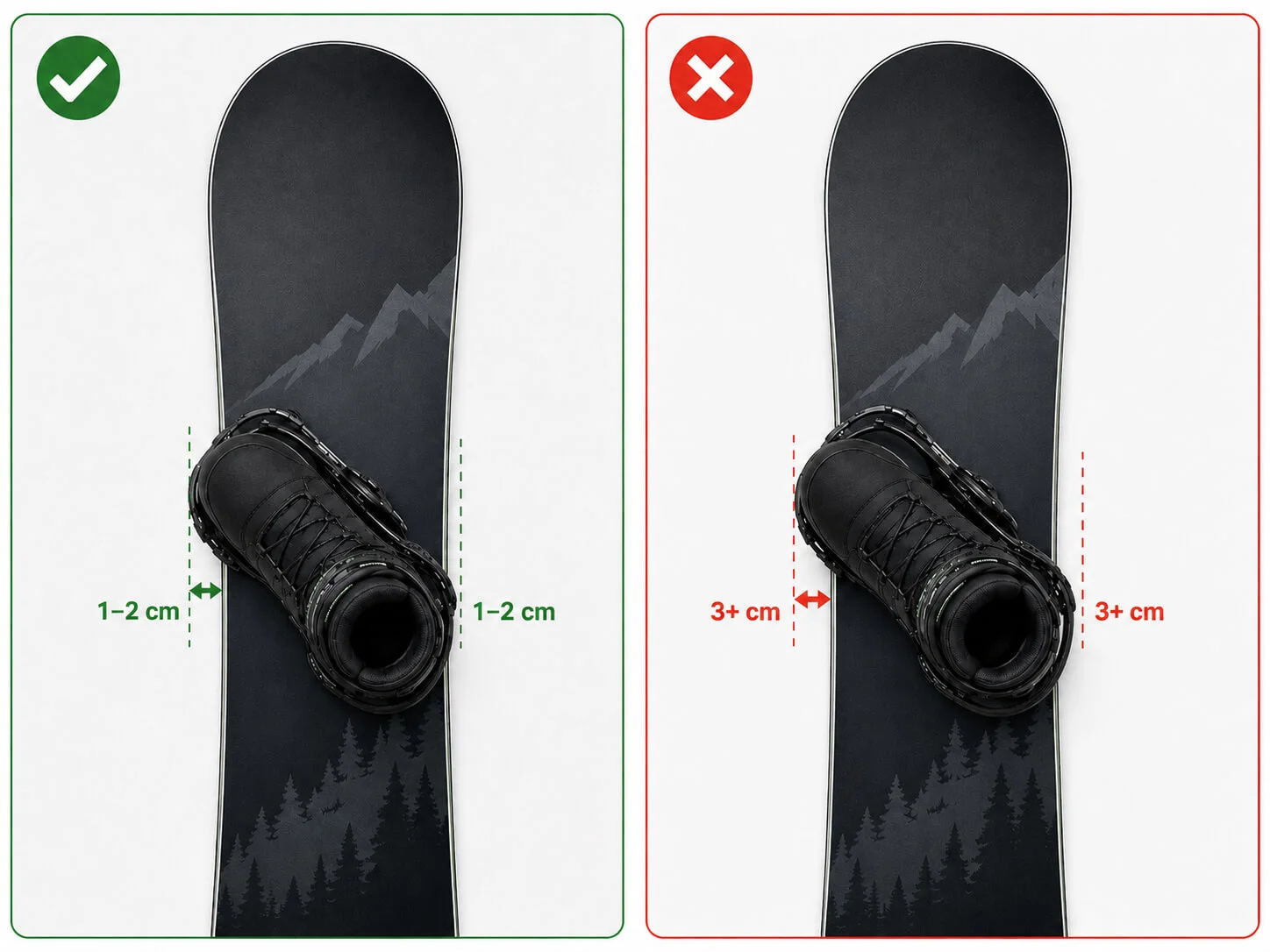
If you carve aggressively, ride steep terrain, or often ride firm snow, do not push the limit. You want more clearance.
If you mostly cruise, skid turns, ride soft snow, or are still learning, you can get away with a bit more.
But remember: the whole point is to buy a board that still works when you improve.
Snowboard width chart by boot size
This is a practical guide, not a law of physics. Different brands measure and shape boards differently.
Still, this gives you a strong starting point.
| Mondo | US Men | US Women | UK | EU | Suggested waist width |
|---|---|---|---|---|---|
| 24–25.5 | 6–7.5 | 7–8.5 | 5–6.5 | 38–40 | ~240–250 mm |
| 26–27 | 8–9 | 9–10 | 7–8 | 40.5–42 | ~245–254 mm |
| 27.5 | 9.5 | 10.5 | 8.5–9 | 42.5–43 | ~250–258 mm |
| 28 | 10 | 11 | 9–9.5 | 43–44 | ~254–260 mm |
| 28.5 | 10.5 | 11.5 | 9.5–10 | 44 | ~258–264 mm |
| 29 | 11 | 12 | 10–10.5 | 44.5–45 | ~260–266 mm |
| 29.5–30 | 11.5–12 | 12.5–13 | 10.5–11.5 | 45–46 | ~264–270 mm |
| 30.5–31 | 12.5–13 | 13.5–14 | 11.5–12.5 | 46–47 | ~268–275 mm |
| 31.5+ | 13.5+ | 14.5+ | 12.5+ | 47.5+ | ~275 mm+ |
How to check your snowboard width at home
If you already have a board, boots, and bindings, do this.
- Put your boots in your bindings.
- Set your normal stance angles.
- Center the boots properly over the board.
- Look at the toe and heel overhang.
- Make sure the overhang is roughly even.
- Tip the board gently onto the toe edge and heel edge.
- Look at how soon the boot touches the ground.
You are looking for a clean, balanced setup.
A little toe and heel overhang is normal.
A lot of overhang, especially if the boot touches early when you tilt the board, is a warning sign.
Advice by rider level
Beginners
Beginners should not buy a wide snowboard just because it sounds more stable.
Width is not the same as stability. Length, flex, shape, profile, and your stance all matter too.
But beginners also should not avoid wide boards just because they heard wide boards are harder to turn.
If your boots are big, get the width you need.
You may not feel toe or heel drag on your first few days because beginner turns are usually flatter and more skidded. But once you start riding faster and putting the board higher on edge, drag can show up fast.
A good beginner setup should help you now and still make sense when your turns improve.
Intermediate riders
Intermediate riders are often the ones who suddenly notice width problems.
You are no longer just surviving. You are linking cleaner turns, riding faster, exploring steeper runs, maybe starting to carve instead of skid.
That is exactly when toe and heel drag become more obvious.
Signs your board may be too narrow:
- you are fine cruising but wash out when you carve
- your toe-side turns fail when you get lower
- your heel-side edge feels like it loses grip for no clear reason
- you see boot marks in the snow after turns
- you feel nervous committing to an edge
- your boots visibly hang a lot over the board
If this sounds familiar, do not just blame your technique.
Technique matters, of course.
But your setup might be holding you back.
For intermediate riders in the grey zone, I would rather see you slightly over-width than under-width — especially if you want to carve.
Advanced riders
Advanced riders should care less about whether the board says W and more about whether it gives enough clearance for the way they actually ride.
If you are carving deep, riding steeps, or pushing high edge angles, your width needs go up.
The harder you ride on edge, the less drag you can tolerate.
Real examples
Mondo 26 / US Men’s 8 / US Women’s 9
You probably do not need a wide board.
A regular-width snowboard should usually give you plenty of clearance. If anything, going wide may make the board feel slower and harder to get on edge.
Look for a regular board that matches your weight, riding style, and ability level.
Mondo 27.5 / US Men’s 9.5 / US Women’s 10.5
You are still usually fine on regular width, but check the waist width if the board is narrow.
If you ride park or want quick turns, regular width likely makes sense.
If you carve hard or ride a board with a very narrow waist, check your overhang.
Mondo 28 / US Men’s 10 / US Women’s 11
This is where you should pay attention.
Many regular boards will still work, especially if they are not too narrow and you have low-profile boots. But do not blindly buy a narrow regular board.
If you are a beginner or casual rider, a regular or mid-wide board may both work.
If you want to carve, go mid-wide sooner.
Mondo 28.5 / US Men’s 10.5 / US Women’s 11.5
Welcome to the grey zone.
You might be fine on the right regular board. You might also be much happier on a mid-wide or wide board.
For most all-mountain riders, this is where I start leaning wider — especially if you ride fast, carve, or want a setup you will not outgrow technically.
Mondo 29 / US Men’s 11 / US Women’s 12
You should usually be looking at wide boards.
Could a regular board work? Sometimes, yes. But it needs to be the right regular board, with enough waist width, sensible binding angles, and boots that do not have a huge outer footprint.
For most riders, wide is the safer call.
Mondo 30+ / US Men’s 12+ / US Women’s 13+
Get a wide board.
And do not stop there. Check the actual waist width.
Some wide boards are still not that wide. If you have really large boots, you may need an extra-wide board, a short-wide shape, or a brand/model that is known to work better for big feet.
At this size, the question is not just “wide or regular?”
The question is:
Is this wide board actually wide enough?
Want the nerdier details?
You have the main answer now.
The sections below are for riders who want to understand the grey zones: waist width, stance angles, boot footprint, volume-shifted boards, and why two boards with the same waist width can still fit differently.
Regular, mid-wide, wide, extra-wide: what do the labels mean?
Snowboard width labels are helpful, but they are not perfect.
In general:
| Width label | Typical waist width |
|---|---|
| Narrow | under ~245 mm |
| Regular | ~245–255 mm |
| Mid-wide | ~255–262 mm |
| Wide | ~260–270 mm |
| Extra-wide / ultra-wide | ~270 mm+ |
But do not trust the label more than the number.
A board called “wide” with a 260 mm waist is not the same as a board with a 275 mm waist.
If you have Mondo 31 boots, both might say wide, but only one of them might actually give you enough room.
This is where big-footed riders get burned.
They buy the wide version, assume they are safe, and still end up with drag because the board is not wide enough for their boots and riding style.
Do not just ask, “Is it wide?”
Ask, “How wide is it?”
Waist width is not the whole story
Most snowboard specs show waist width.
Waist width is the narrowest part of the snowboard, usually around the middle of the board. It is useful because brands publish it, and it gives you a quick way to compare boards.
But your feet are not standing at the waist.
Your bindings sit closer to the inserts, where the board is usually wider than the waist. That means two boards with the same waist width can fit differently under your boots.
Board shape matters too.
A directional freeride board, a twin park board, and a short-wide powder board can all distribute width differently.
So waist width is the easy number.
Width at the inserts is the better number.
The problem is that many brands do not publish width at the inserts. So in real life, we usually use waist width as the starting point, then check the boot and binding fit physically if possible.
Binding angles can change the answer
Your stance angles affect how much of your boot crosses the board.
A boot mounted straight across the board creates more overhang. A boot mounted at more of an angle usually creates less overhang.
For example:
- a back foot at 0° can create more drag risk
- a duck stance like +15° / -15° can reduce effective overhang
- more forward angles can also reduce overhang
This does not mean you should choose weird binding angles just to make a narrow board work.
Your stance should fit your riding.
But if you are on the edge between regular and wide, your binding angles can be the difference between “fine” and “sketchy.”
Low-profile snowboard boots can help
Not all snowboard boots are the same size on the outside.
Some boots have a smaller outer footprint. These are often called low-profile or reduced-footprint boots.
That can help if you are in the grey zone.
A rider with Mondo 28.5 low-profile boots may fit a board that would be sketchy with bulkier boots in the same size.
But do not treat low-profile boots like magic.
They can reduce drag risk.
They do not make size 12 boots disappear.
If you have large boots, you still need to check board width.
Volume-shifted boards are a different thing
Some snowboards are designed to be ridden shorter and wider. These are often called volume-shifted boards.
They are common in powder, freeride, and fun carving shapes.
A volume-shifted board might already be wider than a normal board in the same length, so it can work well for riders with bigger boots.
But it is not automatically the right answer.
A short-wide powder board and a full-size wide all-mountain board can feel very different.
Do not buy a volume-shifted board only because you need width.
Buy it because you also want the ride feel: shorter length, more surface area, quicker turning in tight spots, and often better float for the size.
Width is part of the story.
Shape is the rest.
Should women with larger feet ride men’s or unisex snowboards?
Sometimes, yes.
Not because of gender.
Because of width.
Many women’s boards are narrower, because they are designed around smaller average boot sizes. That works great for many riders. But if you wear larger boots, the women’s version may simply not give you enough platform.
In that case, a unisex or men’s board can make complete sense.
The right board is the one that fits your body, boots, weight, strength, riding style, and terrain — not the one with the right marketing label.
If a women’s board fits, great.
If a unisex board fits better, ride that.
Snowboards do not care what section of the shop they came from.
Should kids or teenagers ride wide boards?
Only if their boots need it.
For growing riders, it can be tempting to buy something with “room to grow.” Be careful with that. A board that is too wide can be harder to control, especially for lighter riders.
But the same rule applies:
Do not let boots drag.
If a teenager has adult-sized boots, they may need an adult-width board even if they are still light. In that case, pay close attention to both width and weight range.
You are trying to match the whole rider, not just the boot size.
Can binding adjustments fix toe or heel drag?
Sometimes they can help.
First, make sure your boots are centered in the bindings and centered over the board.
If you have way more toe overhang than heel overhang, or the other way around, adjust your bindings before blaming the board.
You can also adjust binding angles. More angle can reduce how much your boot sticks out across the board.
But there are limits.
Do not use extreme stance angles just to rescue a board that is obviously too narrow.
Your setup should support your riding, not force you into a stance you do not like.
If the board is too narrow, it is too narrow.
Final verdict: do you need a wide snowboard?
You need a wide snowboard if your boots are large enough that toe or heel drag becomes a real risk.
As a simple rule:
| Boot size | Verdict |
|---|---|
| Under Mondo 27.5 / US Men’s 9.5 / US Women’s 10.5 | Usually regular |
| Around Mondo 28 / US Men’s 10 / US Women’s 11 | Check the board |
| Around Mondo 28.5 / US Men’s 10.5 / US Women’s 11.5 | Mid-wide or wide is often safer |
| Mondo 29+ / US Men’s 11+ / US Women’s 12+ | Usually wide |
| Mondo 30+ / US Men’s 12+ / US Women’s 13+ | Wide, and check that it is actually wide enough |
If you are choosing between slightly too wide and slightly too narrow, slightly too wide is usually the safer mistake — especially once you start carving properly.
Do not buy the widest thing you can find.
Do not squeeze big boots onto a narrow board because you want “quick edge changes.”
Get enough width that your boots clear the snow, your edges can hold, and your board still feels alive under your feet.
That is the sweet spot.